

The Book
The Thought Leadership Handbook: How the Experts Elevate Their Big Ideas—and How You Can Too · Amplify Publishing, July 2026
Most thought leaders figure it out as they go. Nobody hands them the playbook. Bill Sherman, Peter Winick, and Naren Aryal wrote The Thought Leadership Handbook to change that — twenty years of frameworks, tools, and hard-won lessons from hundreds of practitioners. Start with Chapter 12. It’s free, and it begins with a confession.
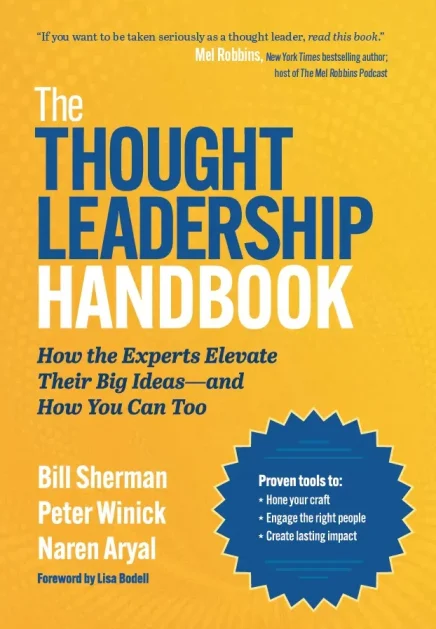
The Thought Leadership Handbook is built on more than 700 conversations with executives, authors, and visionaries, offering a clear roadmap for elevating big ideas and developing a strong thought leadership platform.
TOPICS
We support organizations at any stage of thought leadership with topics including thought leadership best practices, definitions of thought leadership, the creation of thought leadership content and offerings (i.e., modalities), the use of strategy and resources to build thought leadership functions, and the measurement of thought leadership success and impact.
We also share and discuss emerging trends for using thought leadership as a marketing tool as well as those looking to install it as a core competency and value for their organization.
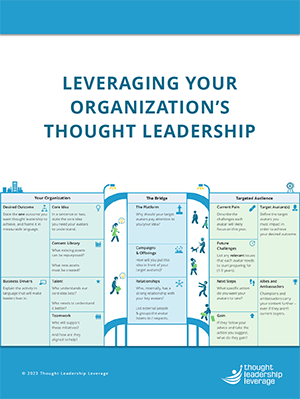
Leveraging Your Organization’s Thought Leadership
This whitepaper is a culmination of insights gathered from Thought Leadership Leverage’s extensive conversations, podcasts, and engagements with over 250 heads of thought leadership across a wide range of organizations. From Fortune 50 companies to small and medium-sized businesses, VC-funded startups, and non-profits, we have gathered valuable knowledge.
The Four Elements of Thought Leadership
Thought Leadership Leverage (TLL) – a firm specializing in thought leadership consulting – has defined the key elements of thought leadership to not only improve their offerings and services, but also codify what good thought leadership should and does look like. Expand your knowledge of the Four Elements: Ideas, Platform, Content and Offerings.
The most consistent measurements for success and impact are:
through websites, social media, in-person (i.e., conferences), etc.
how far thought leadership ideas extend both through the organization as well as through external channels (media, trade publications, clients, etc.).
linking thought leadership to direct customer interactions and sales, whenever possible.
Organizational Thought Leadership, or Org TL as we like to call it, was created when the team at Thought Leadership Leverage realized there was a growing discipline in many corporations to build, design and manage thought leadership.

Bill has spent over twenty years — since 2003 — helping thought leaders codify, productize, and scale their ideas. When Keith Ferrazzi first published Never Eat Alone in 2005, he brought in Bill and his team to codify the frameworks behind the book and turn them into enterprise workshops and training programs for FerrazziGreenlight.
Bill’s signature frameworks — including the Four Elements of Thought Leadership, the Impact Equation, and the Five Avatars — are developed in full at aha-moments.com/frameworks.
Since then, Bill Sherman has worked with hundreds of thought leaders: people preparing their first article or book, Thinkers50 recipients, Fortune 500 CEOs, and New York Times bestselling authors.
Today, Bill Sherman co-hosts the Leveraging Thought Leadership podcast with Peter Winick. Over 700 episodes in, the conversation keeps circling one question: what did it actually take to move an idea into the world?
Bill Sherman lives in Las Vegas, Nevada.

Peter Winick has always been drawn to books, business strategy, and enterprise sales. That combination took him from founding a multi-restaurant delivery company in the 1990s to the thought leadership expert he is today.
Peter orchestrated a rollup of the delivery business and exited. He then helped restructure Rogen International — an Australian L&D firm — shifting their model from open enrollment to high-value, just-in-time presentation skill support.
When Keith Ferrazzi published Never Eat Alone in 2005, Peter wrote him a note, suggesting there was an enterprise sales opportunity for Keith’s ideas. A few meetings later, Peter was Managing Director at Ferrazzi Greenlight, building Keith’s keynote speaking and professional development businesses.
Peter is the founder and CEO of Thought Leadership Leverage (TLL). Since 2008, he and the team have helped thought leaders take their ideas to scale and generate revenue and impact.
His clients have included NYT bestselling authors, Fortune 500 CEOs, Speakers’ Hall of Fame inductees, Thinkers50 award winners, and academics from Yale, Wharton, Harvard, Stanford, and London Business School. He’s also worked with emerging thought leaders — people who have given their first talk or written their first article and need to build a thought leadership strategy.
Peter co-hosts the Leveraging Thought Leadership podcast with Bill Sherman, teaches courses on LinkedIn Learning, and co-authored The Thought Leadership Handbook with Bill Sherman and Naren Aryal.
Peter holds a B.A. in Economics from Hofstra University and lives in Plainview, New York.
Thought Leadership Leverage
A thought leadership strategy should fit the person, not a template. At Thought Leadership Leverage, Bill Sherman and Peter Winick work with practitioners across the full spectrum — from people preparing their first book to enterprise teams building organizational thought leadership programs. They have been doing this for twenty years. They start where the client is.